FAQs - Commercial Signage & Installation Services - San Diego

51 straight answers about commercial printing, vehicle wraps, signage, design and installation in San Diego — grouped by service so you can go straight to what you need.

Search the box below, or jump to a section. Still stuck? Call (619) 997-2280 or send us the details — a real person here will answer it.
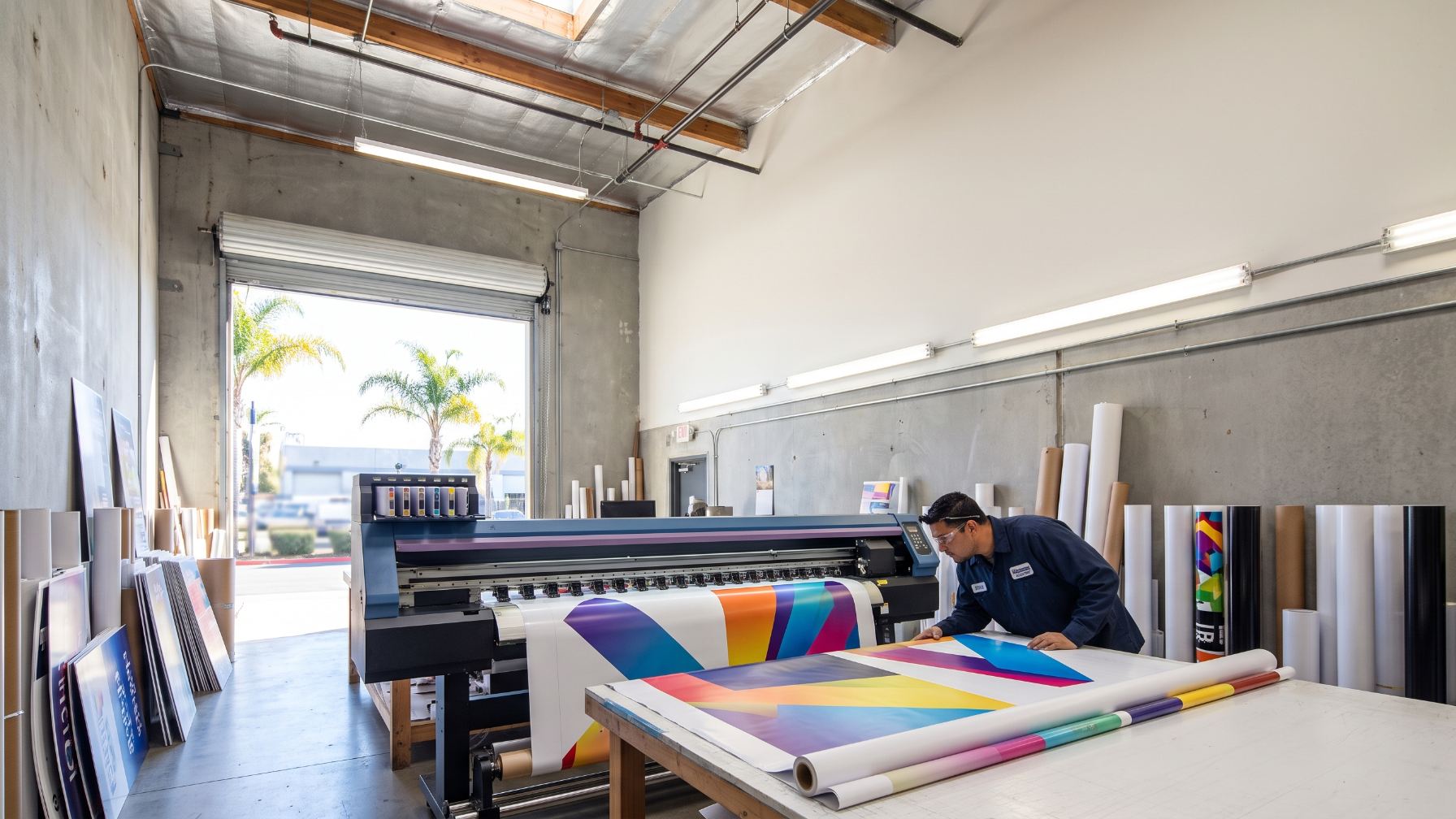
Large format printer running a freshly printed vinyl banner inside the Volume 11 Graphics print shop in San Diego
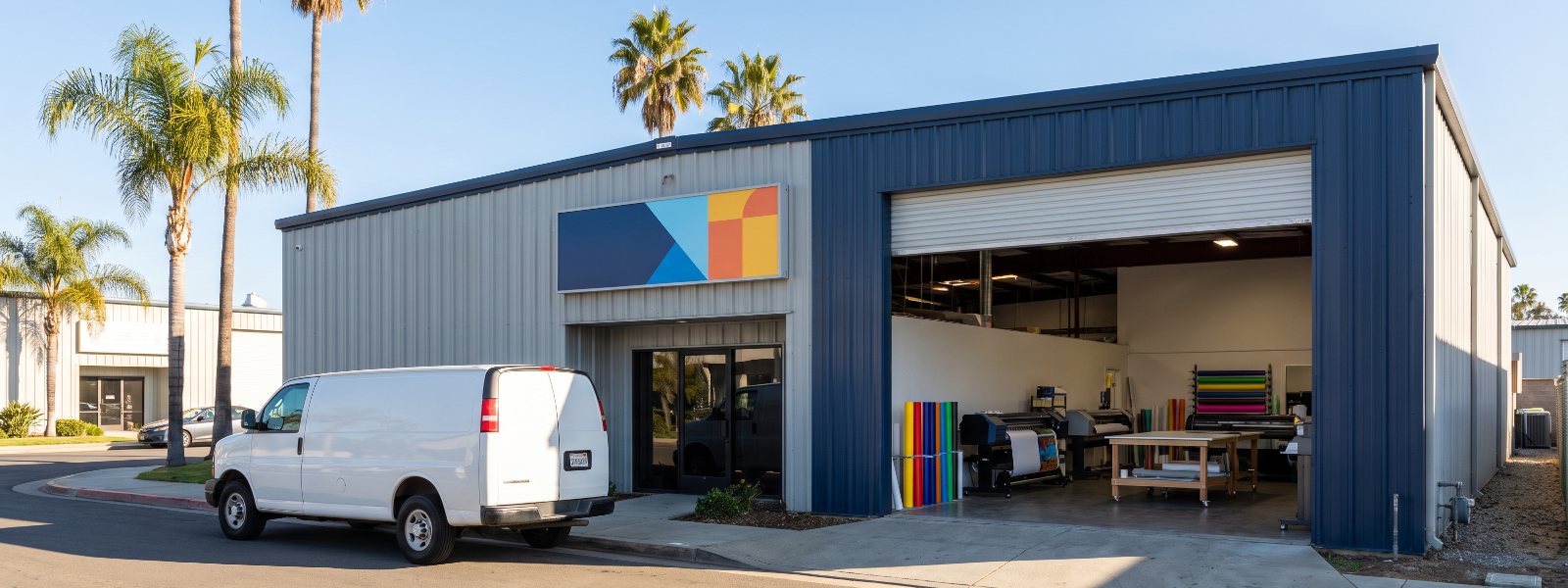
Volume 11 Graphics commercial sign and print shop bay door open in a San Diego industrial park

General Questions

Who we are, where we are, and what it's like to work with us.

What services does Volume 11 Graphics offer?
We do three things: printing, design and installation. Most clients use all three — we take a project from a rough idea through artwork, production and final install. But the services are not bundled. If you already have print-ready files, we will just print them. If you have graphics sitting in a box, we will just install them. Start wherever you actually need help. See our print products, design services and installation services.
Where is Volume 11 Graphics located?
We are at 7044 Convoy Ct, San Diego, CA 92111, in the Kearny Mesa / Convoy district near Hickman Fields. We are a few minutes from I-805 and CA-52, which puts us roughly 15 minutes from downtown and easy to reach from most of the county. There is parking on site and a bay door for large pickups. Call (619) 997-2280 before coming by with a vehicle for a wrap quote.
What areas do you serve?
All of San Diego County. We regularly work in Kearny Mesa, Mira Mesa, Sorrento Valley, Downtown and the Gaslamp Quarter, Chula Vista, La Mesa, El Cajon and up the coast to Carlsbad. Installation crews travel county-wide, and for larger multi-site rollouts we go outside the county as well. See our service areas or our San Diego page.
Are you a printer, a sign shop or a wrap shop?
All three, under one roof, which is the point. A lot of projects fail in the handoffs — the designer sends a file the printer cannot use, or the print gets made in a material the installer cannot hang. When production, design and install sit in the same building, those handoffs stop being your problem. Meet the people who do the work on our team page.
Do you work with businesses, agencies or individuals?
All of them. A large share of our volume is trade work for agencies, designers and other print brokers who need large-format capacity and a shop that will not go around them to their client. We also work directly with contractors, restaurants, retailers, property managers, event planners and individuals who want one canvas print. No account minimums.
Can I see examples of your work?
Yes. Our success stories cover real projects — event builds, fleet wraps, large interior installs. If you want to see a specific material or finish in person, come by the shop on Convoy Ct and we will pull samples. Seeing a 13oz banner next to an 18oz blockout in daylight settles most material questions in about ten seconds.
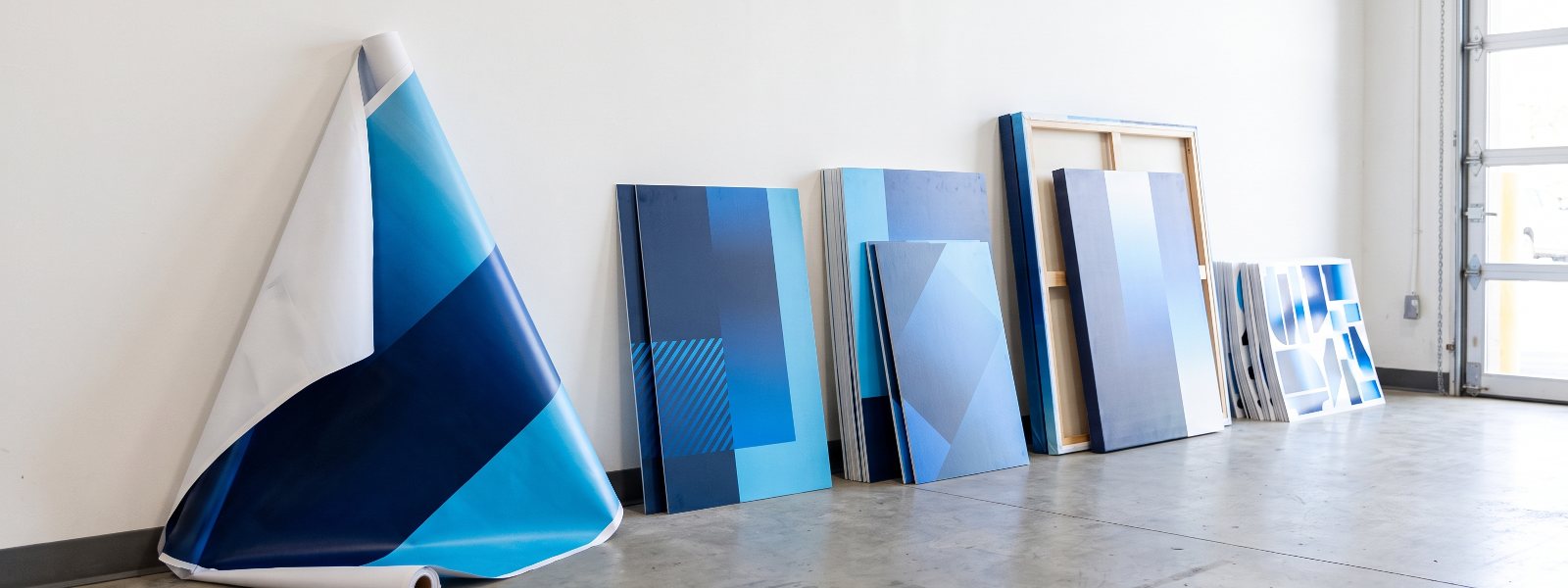
Finished large format printed banners, rigid signs, posters and canvas prints lined up in a San Diego print shop

Printing & Products

Materials, sizes, durability and what we can actually put ink on.

What products can you print?
Banners, vehicle wraps, window graphics, wall murals, decals, posters, rigid signs, canvas prints and vehicle magnets. Beyond the catalog we build custom dimensional displays, backdrops, floor graphics and one-off specialty pieces. Browse everything on our products page.
What is the largest size you can print?
Our large-format rolls run up to five feet wide and effectively unlimited in length. Anything wider gets printed in panels and seamed — that is normal practice for building wraps and full-wall murals, and a good installer makes the seams disappear at normal viewing distance. There is no practical size ceiling on a wall mural; the limit is the wall.
What is the difference between a 13oz and an 18oz vinyl banner?
Weight per square yard, which translates to thickness and durability. 13oz is the standard scrim banner — right for events, grand openings, real estate and anything hanging for a season. 18oz is heavier, stiffer and holds up better to wind and long outdoor exposure. There is also blockout vinyl with a black core so a double-sided banner does not ghost through. For a two-week event, 13oz. For a fence banner living outside for two years, 18oz. See banners.
How long will an outdoor banner last in San Diego?
A properly hemmed and grommeted 13oz banner typically holds good color for one to two years outdoors here; 18oz pushes further. San Diego is actually kind to vinyl — no freeze-thaw and moderate temperatures — but UV is relentless and coastal wind is what usually kills a banner, not sun. Wind tears at the grommets. If it is going somewhere exposed, ask us about wind slits or a mesh banner instead.
Do you print both indoor and outdoor graphics?
Yes, and the material choice is completely different. Indoor work can use cheaper substrates and non-laminated prints. Outdoor work needs UV-stable inks, an over-laminate and a material rated for the exposure. Tell us where it is going and how long it needs to survive and we will spec it — that one question prevents most of the failures we get called in to fix.
Can you do custom sizes and shapes?
Everything we do is custom. There is no fixed size menu. We contour-cut decals and rigid signs to any shape you can supply as a vector cut path, and we regularly produce odd sizes to fit a specific wall, window, vehicle panel or trade show booth footprint.
What is perforated window film and when should I use it?
Perf film is vinyl punched with a pattern of tiny holes — typically 50/50 or 60/40 print-to-hole ratio. From outside it reads as a solid printed graphic; from inside you can still see out, and daylight still comes through. It is the right answer for storefront windows, conference rooms and vehicle rear windows where you want the graphic without blinding the people inside. More on window graphics.
Do you print rigid signs, and in what materials?
Yes. Common substrates are corrugated plastic for short-term yard and site signs, PVC and Sintra for interior signage, ACM / aluminum composite for exterior building and monument signs, and acrylic for premium interior work — often paired with stand-offs for a floating look. Each has a different lifespan and price. See signs.
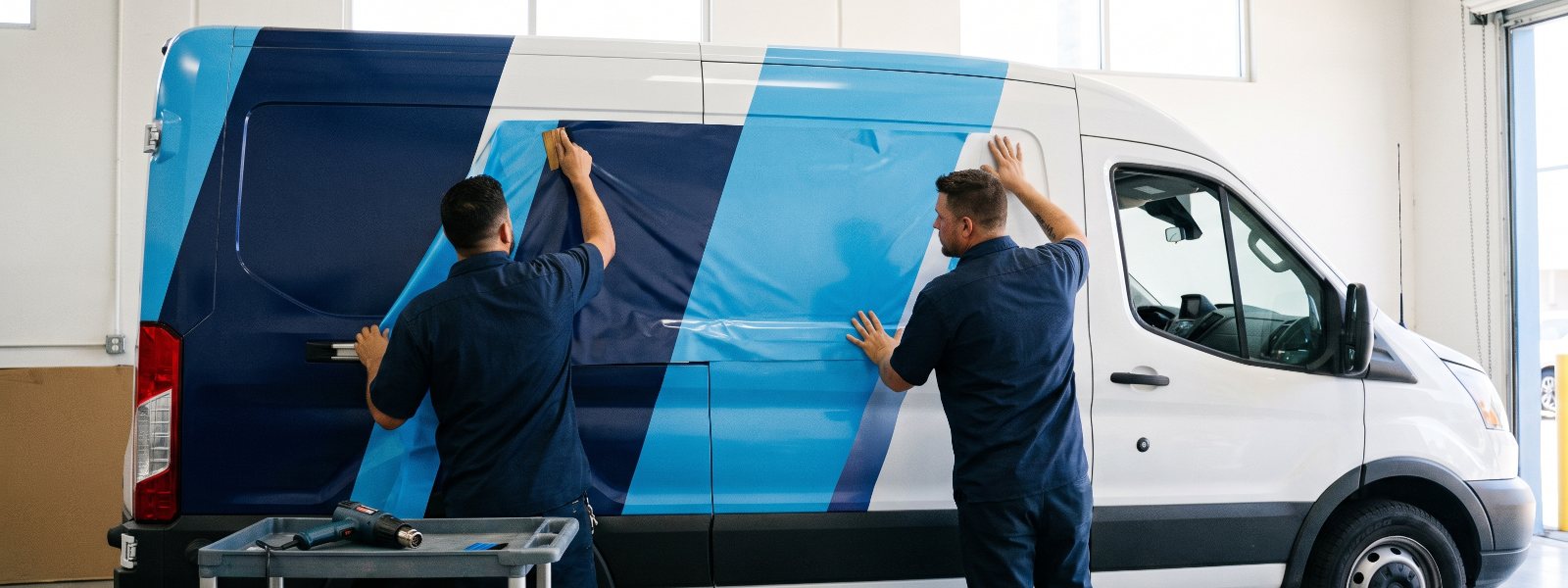
Certified installer squeegeeing vinyl onto a white commercial van in a San Diego vehicle wrap bay

Vehicle Wraps

Cost, durability, coverage, care — the questions everyone asks before wrapping a vehicle.

How much does a vehicle wrap cost in San Diego?
Ranges, because the vehicle drives the price: a partial wrap or spot-graphics package typically runs $1,500–$3,000; a full sedan or small SUV wrap usually lands $3,000–$5,000; a full cargo van, box truck or Sprinter generally starts around $4,500 and climbs with size and complexity. Chrome, color-shift and textured films cost significantly more. Those are honest San Diego ballparks, not a quote — body style, coverage, film choice and design time all move the number. Send us the vehicle and we will price it properly.
Why is a van or box truck more expensive to wrap than a car?
Surface area and geometry. A box truck has far more square footage of film, and large flat panels wider than our roll require paneling and seaming. Vans have deep body channels, rivets, corrugation and door hardware that all have to be worked around or removed and reinstalled — that is labor, not material. A car with smooth curves can genuinely be faster to wrap than a smaller van with a difficult body.
How long does a vehicle wrap last?
With quality cast film and a laminate, expect five to seven years on vertical surfaces. In San Diego the horizontal surfaces — hood and roof — are what age first, because that is where UV hits hardest, and those may show fade or lift a year or two before the sides do. Garage-kept or shaded vehicles run at the long end of the range. A wrap parked outside all day every day runs at the short end.
Will a vehicle wrap damage my paint?
Not on factory OEM paint in good condition — applied correctly and removed within its service life, vinyl actually protects the paint underneath from UV and small chips. The real risks are aftermarket or resprayed paint, which can lift with the film, and leaving a wrap on for a decade, at which point the adhesive has cured hard and removal gets ugly. Tell us if the vehicle has been repainted; it changes what we recommend.
What is the difference between a full wrap, a partial wrap and decals?
A full wrap covers every painted surface — total color change, maximum impact. A partial wrap covers a defined portion, commonly the lower two-thirds, rear and doors, using the vehicle's existing color as part of the design. Decals or spot graphics are just cut logos, lettering and contact info on bare paint. Most work vans get the most advertising value per dollar from a good partial wrap, not a full one.
Can I wrap a leased vehicle?
Usually yes, and it is common — a wrap is removable and the paint underneath comes back clean. But check your lease agreement first, because some explicitly prohibit exterior modification, and plan for professional removal before you turn the vehicle in. Removal is a real line item; budget for it rather than being surprised by it.
How long does it take to wrap a vehicle?
Plan on two to four days in the shop for a full wrap once artwork is approved: a day for cleaning and prep, one to two for application, and time for the film to relax and post-heat before it goes back out. Partial wraps and decal packages are often a single day. Design and proofing happen before that and are usually the longer part of the calendar.
How do I wash and care for a wrapped vehicle?
Hand wash with mild soap and a soft mitt, rinse top-down, and dry with a microfiber towel. Avoid automatic brush car washes — the brushes catch edges and seams and lift them. Keep pressure washers below roughly 1,500 psi, use a wide fan tip and stay a foot back, never spraying straight into an edge. Remove bird droppings, bug splatter and fuel spills promptly; they etch vinyl faster than they etch paint. Park in shade when you reasonably can.
Do you wrap fleets, and can you keep multiple vehicles consistent?
Yes — fleet work is a large part of our wrap lab. We build a template per body style, keep the artwork and cut files on record, and can stage vehicles through so you are never missing your whole fleet at once. When you add a truck in eighteen months, we pull the same file and it matches. More on vehicle wraps.
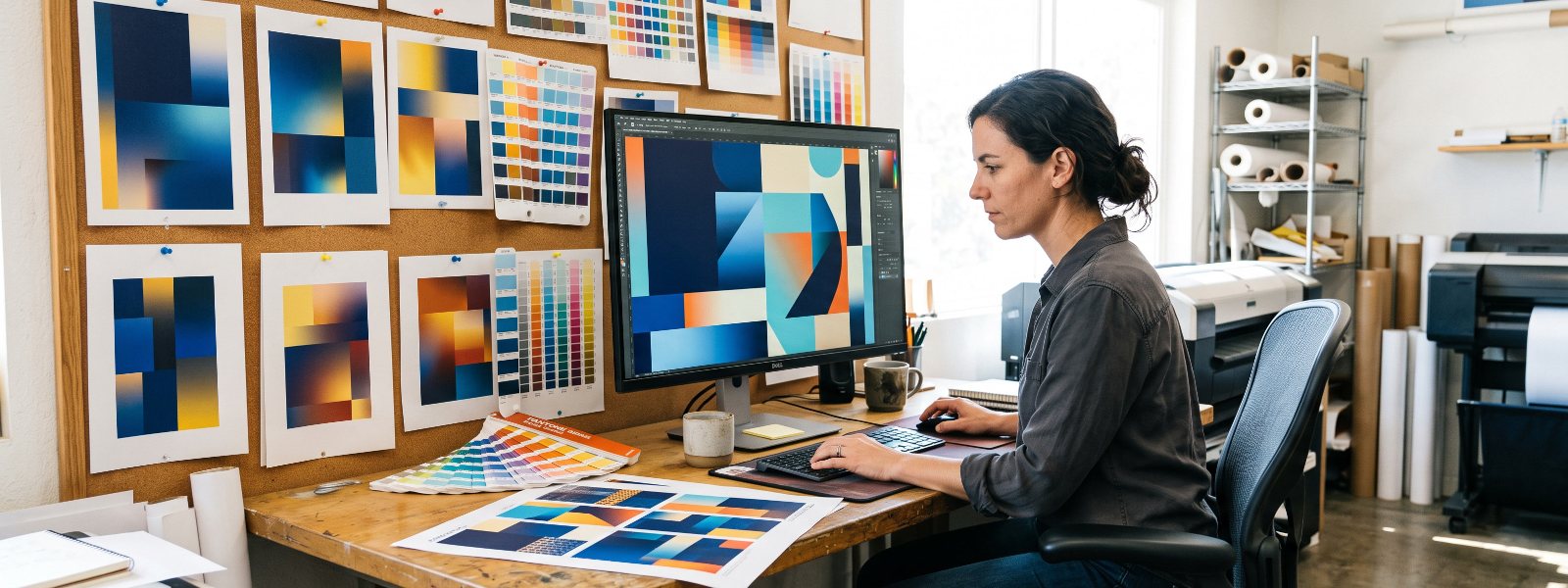
Designer reviewing a large format graphic layout on a widescreen monitor with proof prints pinned behind

Design Services

From napkin sketch to production-ready art — or just cleaning up what you already have.

Do you offer design services?
Yes. We have in-house designers who can take a project from a rough concept, a sketch or even a verbal description through to production-ready artwork. We can also work purely as a production shop on files you or your agency supply. See design services.
Can you work with my existing artwork, or do I need to start over?
Either way works. If you have print-ready files, we print them. If you have a logo and nothing else, we build around it. If what you have is a low-resolution JPG pulled off a website, we will tell you honestly whether it can be salvaged at size or needs to be redrawn — and redrawing a logo as clean vector art is usually a small, worthwhile one-time cost that pays off on every job after it.
How much does design cost?
It depends entirely on scope — laying out a banner from supplied assets is a fraction of designing a full vehicle wrap from scratch. We quote design as part of the project rather than by a rate card, and we tell you up front what is included so it does not creep. If your budget is fixed, say so and we will scope the design to fit it.
Do you design trade show and event graphics?
Yes, and it is a specialty. Trade show and event work has constraints most graphics do not — booth footprint rules, hanging limits, sight lines, load-in windows and the fact that everything has to survive being packed and shipped. We design around those from the start. See event design.
Can you help with a full branded environment, not just one sign?
That is what our displays and branding work is. Lobbies, retail interiors, office fit-outs, showrooms — wall graphics, dimensional lettering, window film, wayfinding and displays designed as one system so the space reads as one brand rather than as six vendors' work bolted together.
Will I see a proof before you print?
Always. Nothing goes to production without your written approval on a proof showing size, layout, colors and material. For color-critical work we can also produce a physical printed proof on the actual substrate before committing to the full run — worth it on large jobs where a color surprise is expensive.
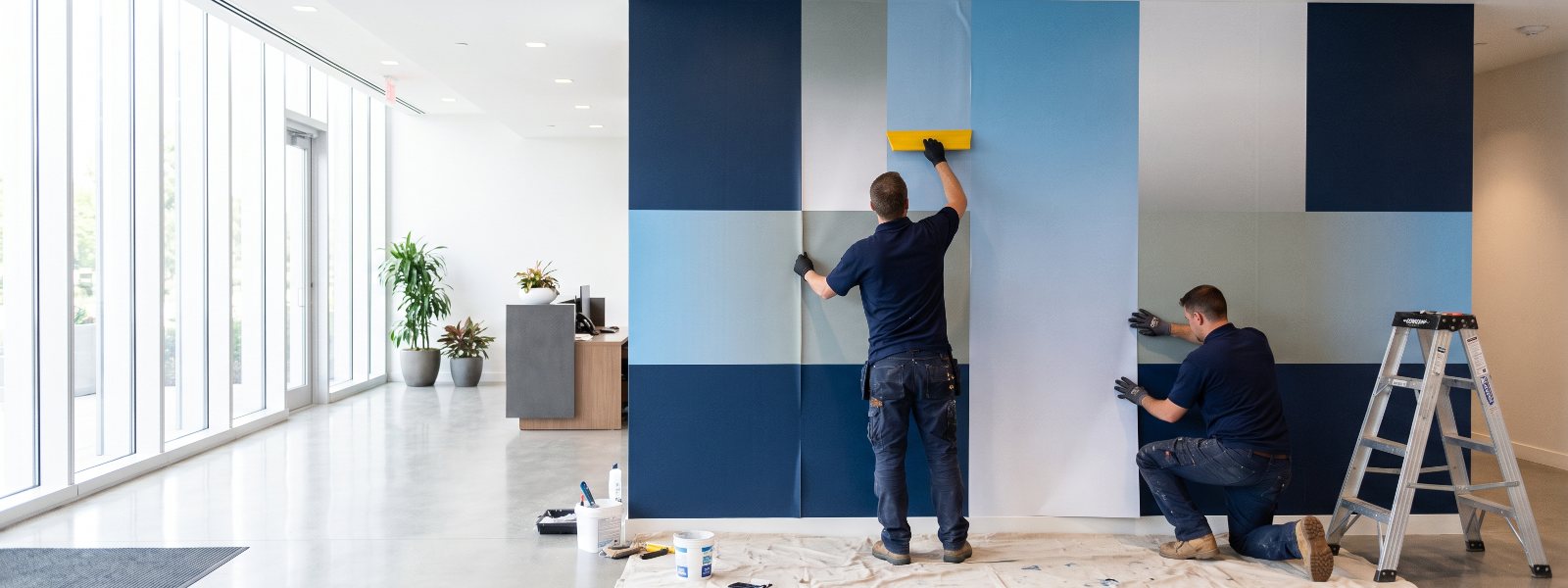
Two installers applying a large vinyl wall mural in a bright modern office lobby

Installation & Site Work

Site visits, wall prep, mounting hardware and getting graphics on the wall straight.

Can you install the graphics you print?
Yes — we have certified professional installers on staff who handle vehicle wraps, window graphics, wall murals, dimensional lettering and displays. Installation is where most graphics projects visibly succeed or fail, and it is the part we would least recommend improvising. See installation services.
Will you install graphics you didn't print?
Yes. If you have graphics from another supplier, or your agency printed elsewhere and needs local hands, we will install them. We will look at the material and the substrate first and tell you honestly whether it will hold — we would rather flag a bad film choice before install than get called back about lifting edges in three weeks.
Do you do site visits?
Yes, for larger custom work — wall wraps, murals, dimensional displays, storefronts, multi-room interior programs. We come out, measure the actual space, check the wall surface and lighting, and talk through what will actually work there. Measurements taken off a phone photo are how you end up with a mural six inches short.
Why does wall preparation matter for a mural?
Because vinyl only sticks to what is under it. Fresh paint needs to cure — typically three to four weeks — before film goes on, or the adhesive pulls the paint off. Heavy orange-peel or knockdown texture, chalky or dusty surfaces, and cinder block all cause failure with standard film. We assess the surface, recommend the right film or a smoothing step, and tell you if the wall needs work first. See wall prep.
What are stand-offs and when would I want them?
Stand-offs are polished metal barrel mounts that hold an acrylic, metal or PVC panel a short distance off the wall. The gap creates a shadow line that makes the sign read as an object rather than a sticker — it is the standard look for lobby signage, donor walls and conference room ID. More on stand-offs.
Do you offer custom framing?
Yes. We do custom framing for canvas prints, fine art, photography and printed pieces — including oversized work that standard frame shops will not take. If it came off our printers, we can finish and hang it too.
Can you install wall murals in an occupied office or retail space?
Yes, and we do it constantly. Wall graphics install with minimal noise, no dust and no fumes, so a single wall can often go up during business hours. For larger programs, or anywhere we need to move furniture and set ladders, we schedule after hours or on weekends so your operation does not stop. See wall murals.
How long does an installation take?
A storefront window graphic or a single wall panel is usually a couple of hours. A full-wall mural runs half a day to a full day depending on size, height and surface. Vehicle wraps are measured in days, not hours. Complex multi-room or multi-site programs get a schedule up front so you know exactly which spaces are affected when.
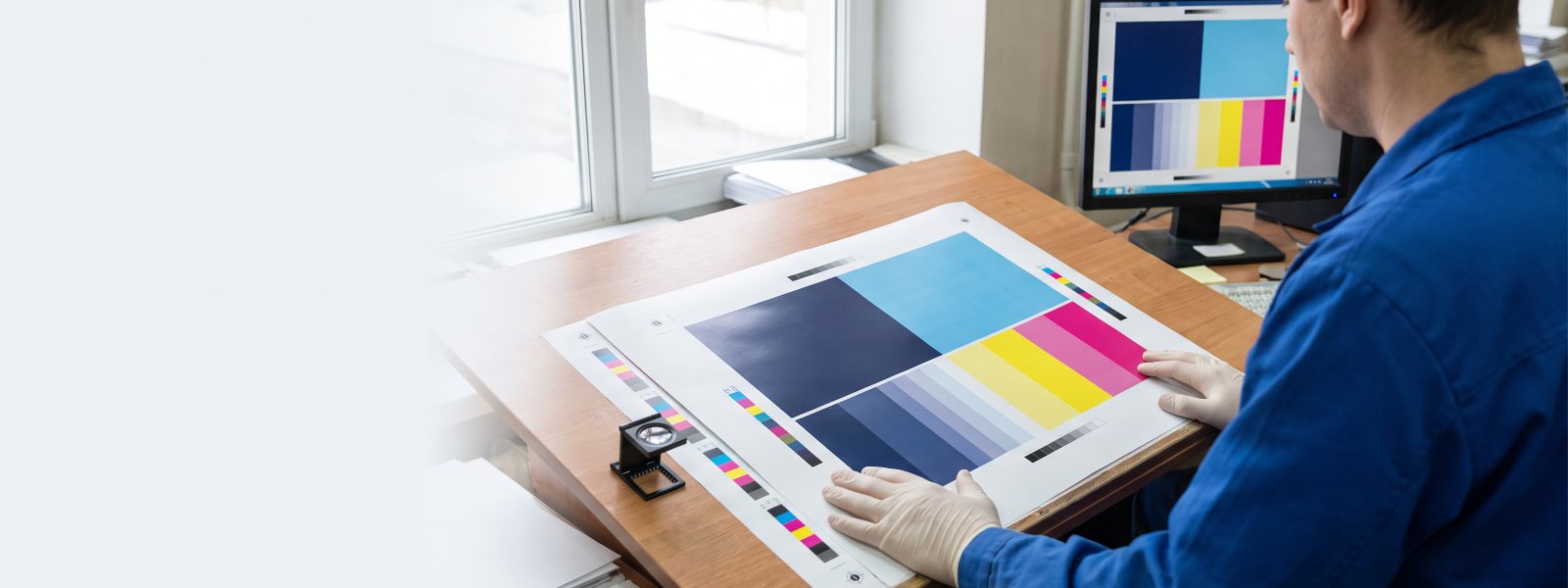
Prepress technician checking a printed proof against a calibrated monitor with a loupe and color bars

Artwork & File Prep

Resolution, file formats, color and bleed — how to send us files that print right the first time.

What file formats do you accept?
Preferred: AI, EPS, PDF (vector, fonts outlined) for anything with type or logos. We also accept high-resolution TIFF, PSD, JPG and PNG for photographic content. Send us the largest, least-compressed version you have — a file can always be reduced, never truly enlarged. Upload through submit files.
What is the difference between raster and vector files?
Raster files — JPG, PNG, TIFF, PSD — are grids of pixels. Enlarge one past its native size and it goes soft or blocky. Vector files — AI, EPS, vector PDF — are mathematical descriptions of shapes, so they scale to any size with perfectly sharp edges. For large-format work, vector is ideal for logos, type and line art. High-resolution raster is fine and often necessary for photographs.
What resolution do my files need to be?
The honest answer is that it depends on viewing distance, not a fixed number. We generally want 300 ppi at final print size for anything viewed up close, and 150 ppi at final size is comfortable for most large-format work. A billboard or building wrap seen from across a parking lot can go far lower — sometimes 20–50 ppi at full scale — and still look perfect. A good rule: build the file at 1/10 scale at 300 ppi and it will be 30 ppi at full size, which is fine at distance.
Should I send RGB or CMYK?
Send us what you have and tell us which it is. Our printers use a wider gamut than standard CMYK, so we often get better results converting from your original RGB than from an already-converted CMYK file. What matters more: if you have specific brand colors, give us the Pantone / PMS numbers rather than asking us to eyeball them from a screen.
Will the printed colors match what I see on my screen?
Close, but not identical — and anyone who promises exact is not being straight with you. Monitors emit light, print reflects it, and no two uncalibrated screens agree with each other anyway. Bright saturated blues, greens and oranges are the usual gap. For color-critical jobs we print a physical proof on the actual material so you approve the real thing, not a picture of it.
How much bleed and margin should I include?
Include at least 0.25" of bleed on all sides for most printed pieces, and keep critical text and logos at least 0.5" inside the trim. Banners need more — leave 2–3" clear around the perimeter so hems and grommets do not eat your artwork. For vehicle wraps, do not lay out to the panel edge; we will template the actual vehicle.
How do I send you large files?
Use our submit files page — it handles large uploads without the size limits that break email attachments. Dropbox, Google Drive and WeTransfer links work too. Include the finished size, quantity, material if you know it, and the deadline in the same message; it saves a round trip.
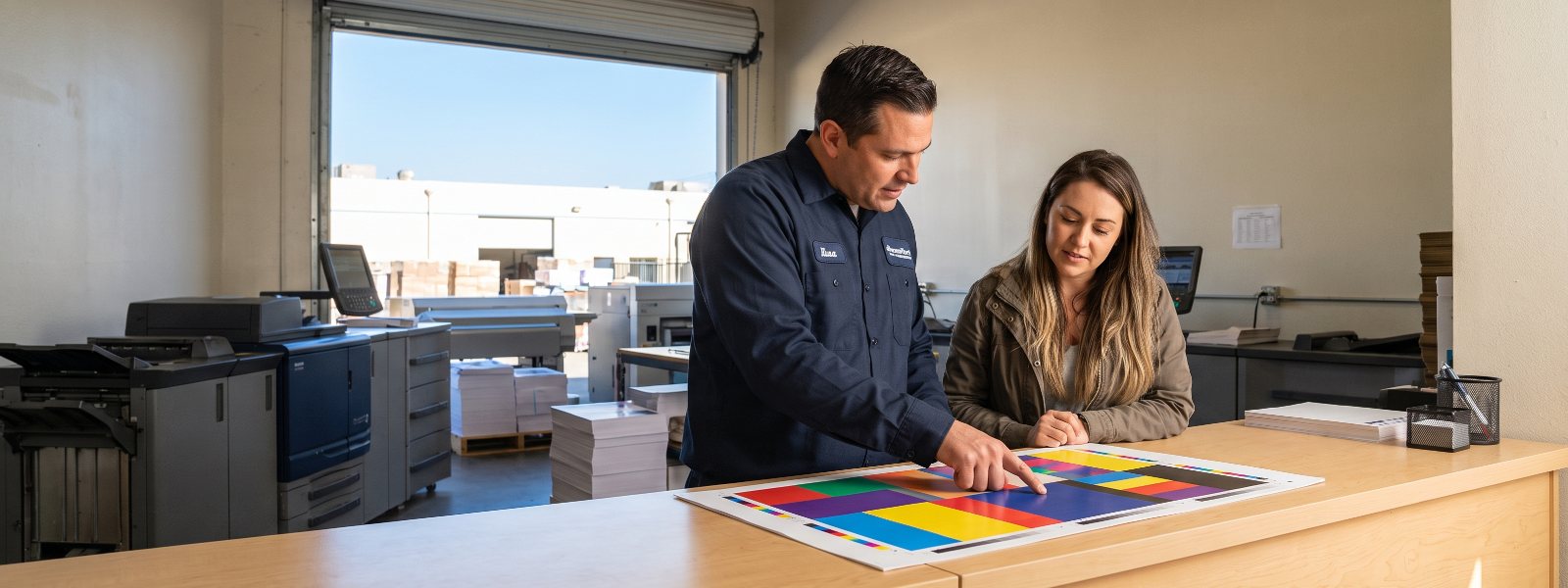
Volume 11 representative reviewing a printed proof with a customer at the San Diego shop counter

Pricing, Turnaround & Ordering

What things cost, how fast we can move, and how to get started.

How do I get a quote?
Tell us four things: what it is, what size, how many, and when you need it. If you know the material and have artwork, include those too. Send it through our contact page or call (619) 997-2280. Most straightforward quotes come back same or next business day; vehicle wraps and large custom installs may need a look at the vehicle or the site first.
What is your typical turnaround time?
It depends on the product. Simple poster boards can sometimes be ready within an hour, though we prefer one to two days to do the finishing properly. Banners and standard signage generally run two to five business days from artwork approval. Vehicle wraps are two to four days in the shop after design sign-off. Large custom installs are scheduled around a site visit. The clock starts at proof approval, not at first contact — so approve fast if the deadline is tight.
Do you offer rush or same-day printing?
Often, yes. We would rather tell you honestly what is possible than promise a date we will miss. Call, give us the real deadline, and we will tell you straight whether it fits — and what it would cost to move it up. Same-day is most realistic on simple flat-print items; anything requiring lamination, cutting, sewing or install needs more room.
Do you require a deposit?
For most custom work, yes — everything we produce is made specifically for you and cannot be resold, so a deposit is standard before production begins. Terms depend on the size of the job and whether you are an established account. We will lay it out clearly in your quote; no surprises at pickup.
Do you offer trade or wholesale pricing for agencies and resellers?
Yes. We do a significant amount of white-label production for agencies, designers, sign companies and print brokers who need large-format capacity. We work behind your brand and we do not go around you to your client. Ask about trade pricing when you reach out.
Do you ship, or is it local pickup only?
Both. Most local clients pick up at 7044 Convoy Ct or have us deliver and install. We also ship nationwide — banners, decals, canvas and rigid signage all travel fine when packed properly. Vehicle wraps obviously need the vehicle here, but we do print and ship wrap kits to installers elsewhere. See recent work in our success stories.

Still have a question?

If it is not answered above, it is probably a good question. Tell us what you are trying to make, how big, how many and when you need it — we will tell you straight whether we can do it and what it will take.

Call (619) 997-2280 Request a Quote Submit Files